
How Divorce With Children Changes Your Career

Divorce with children forces you to rethink your career. Your constraints around time, income, and responsibility change, sometimes giving you more freedom but also potentially limiting work hours.
I went through this myself. After divorce, my finances were turned upside down. I didn’t stop working or lose motivation. What changed was how income was taxed, assessed, and shared. As well, there were now certain times when my children were with me when working was no longer feasible.
Most people keep using a pre-divorce career model for too long. The flexible, two-parent model assumes you can prioritise work when needed. But once you are separated with a parenting plan, previous assumptions around commitments and flexibility no longer hold.
Key Takeaways
- Divorce with children changes your career constraints immediately. Time and availability are no longer flexible.
- A parenting plan limits how work can be structured. When the kids are with you, you are fully responsible.
- Jobs built around long hours, travel, or constant availability are harder to sustain.
- Flexible work and WFH move from optional to necessary.
- Extra income often delivers limited benefit once tax, child support, and means testing apply.
- Child support links income and care directly to financial outcomes.
- Career decisions need to be judged on net results, not gross salary.
- Stability and flexibility matter more than rapid progression.
Parenting Plans Put Hard Limits on Work
When you have children in your care, you’re solely responsible for them during that time. If they’re sick, unsettled, or need supervision, there is no other parent in the house to give you a break.
You cannot structure your working life around constant availability anymore, because your kids are counting on you alone when they are with you.
Jobs that depend on unpredictable hours, late meetings, travel, or constant responsiveness become hard to sustain. Not because you lack commitment, but because any volatility may conflict with your parenting obligations.
Amicable and Non-Amicable Separations
Whether a separation is amicable or hostile can affect timing of when you’re on parenting duties. In amicable separations, parents may cooperate around work demands, with some give and take to allow parents to work unexpectedly when necessary.
In non-amicable separations, the parenting schedule becomes much more locked in. You can’t switch nights with a simple text exchange. You may have no flexibility to adapt the schedule on the fly.
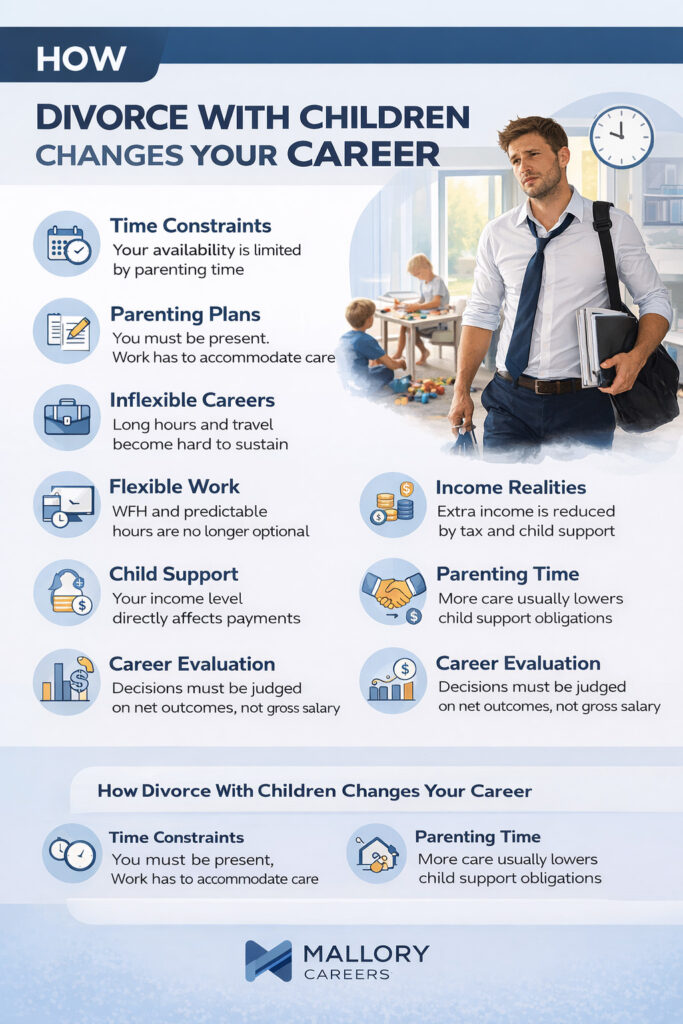
How to read the infographic
The infographic summarises the constraints that divorce with children places on work. Parenting plans limit availability, child support links income and care to financial outcomes, and tax and means testing weaken the payoff from extra hours.
Housing affordability is another change. Our rent affordability calculator shows how much rent you can realistically afford based on your income, tax, and common assessment rules. It’s useful when weighing reduced hours, flexible work, or post-separation income changes.
Flexible Work Is No Longer Optional
Being able to take time off work as required becomes non-negotiable once you are divorced with kids. You need flexibility because you can no longer rely on the other parent to help out as required.
Working from home is a good option if available. WFH allows you to manage school routines, illness, and holidays while remaining employed. It also establishes a visible, defensible pattern of involvement with your child. A slightly lower salary with reliable WFH may produce better family outcomes than a higher salary without it.
Reduced hours can also make sense. Four-day weeks and part-time arrangements are often framed as career limiting. After separation, they are rational adjustments. Working long hours becomes a logistical problem, often with a low payoff when you consider child support payments on top of taxes.
Ideal Post-Divorce Careers
The career paths that tend to work best after divorce with children are those with well-contained work hours.
Roles with stable hours and low travel tend to outperform higher-status jobs that demand constant responsiveness. Examples are government roles, in-house corporate roles with clear coverage arrangements, and technical or commercial roles where performance can be delivered in defined blocks of time rather than through late nights.
Remote-friendly professional work can be good if it is measurable and output-based. Examples include analysis, reporting, project delivery, drafting, design, coding, and advisory roles where meetings can be scheduled and the rest of the work is independent.
If you are self-employed, the same rule applies. The best models are those where clients can be served inside your available windows and where you are not trapped by emergency call-outs or constant availability. A smaller, steadier client base with clean boundaries often outperforms chasing growth that forces you away from your care time.
Child Support in Australia
Child support is one of the most important factors shaping post-divorce career decisions in Australia, and it is heavily income-based.
In most cases, the amount a parent pays or receives is driven by taxable income, adjusted for how much care each parent provides. The system uses a legislated formula administered by Services Australia. Parents do not negotiate the amount by default. You lodge a tax return, income and care levels are assessed, and payments are calculated.
As income rises, child support generally rises with it. Almost all forms of income are included, and tax strategies such as salary sacrifice fail, with the amounts added back on. This weakens the link between extra effort and extra reward. Overtime, bonuses, and small pay rises often deliver less financial benefit than expected once tax and child support are taken into account.
Parenting time affects child support. The number of nights children spend with each parent changes how costs are assumed to be shared. More care typically reduces payments if you’re a payer or increases payments if you’re a receiver.
Your job must actually allow you to exercise your parenting time. A role that limits your scheduled time will lock in a worse payment arrangement for you.
Official source
Child support assessments in Australia take into account both parents’ incomes and the amount of care each parent provides, measured by the number of nights a child spends with each parent. Care levels affect how child-raising costs are shared and therefore how much child support is payable.
Source: Services Australia
https://www.servicesaustralia.gov.au/child-support-assessment
About childsupportaustralia.com
A useful independent resource for Australian parents is childsupportaustralia.com.
The site offers a free child support calculator based on the Australian formula. The elegant calculator lets parents quickly test scenarios and see how changes in income or care arrangements may affect estimated payments. Seeing how inputs affect results is useful when considering career changes, reduced hours, or different parenting schedules.
Childsupportaustralia.com also explains child support calculations in plain language. The site is neutral, formula-based, and informational. It does not provide legal advice or advocacy. The value of the free and independent service is helping parents understand the calculation, check assumptions, and make better-informed financial decisions.
Why Standard Career Advice Breaks Down
Standard career advice assumes extra effort leads to extra reward, and income growth improves security.
After divorce with children, those assumptions often fail. High marginal tax rates, means testing, and child support weaken the link between effort and reward. Ultimately, your children now require you to be available for them whenever you have scheduled parenting time.
