
Career Analysis: SCU Online Master of Education

The online Master of Education from Southern Cross University is a strong career move for teachers who want to step into leadership, wellbeing, inclusion, or school management roles. Its value comes from how the degree builds organisational, evaluative, and people-management capability.
This is not a generic Master of Education. Structurally, it behaves more like a leadership preparation degree for schools than a pedagogical or research-led qualification.
Based on our analysis of the Master of Education from SCU Online and similar online degrees, this program is best suited to experienced teachers aiming for roles such as assistant principal, deputy principal, wellbeing coordinator, inclusion lead, teaching and learning leader, or broader school management positions.
Program Structure
The SCU Online Master of Education is an eight-unit postgraduate degree completed online. Students do the course part-time, with multiple intakes per year and regular study blocks that allow the degree to be completed while working.
Course information is published on the official page:
https://online.scu.edu.au/online-courses/master-education
Core units (completed by all students)
The following four units form the foundation of the degree and build leadership, professional learning and applied evaluation capability:
- Contemporary Educational Leadership
- Contemporary Educational Contexts
- Leading Professional Learning
- Educational Investigation
Specialisation pathways
Students complete one structured pathway (four units) that shapes the focus of the degree:
Educational Leadership
- Human Resource Management
- Evaluation for Improved Teaching and Learning
- Accounting for Managers or Project Management Principles
- Organisational Behaviour or The Positive Leader
Educational Wellbeing
- Educational Leadership and Wellbeing
- Enhancing Student Wellbeing
- Valuing Diversity
- Supporting Students in Difficult Times
Educational Inclusion and Diversity
- Inclusive Education: Theory, Policy and Practice
- Technology and Collaboration to Support Learning and Participation
- Valuing Diversity
- Supporting Students in Difficult Times
This analysis is independent of the university and is based on curriculum structure, not marketing material.
Optional: Get the official course brochure
You’ll receive the brochure instantly with detailed program information. The university may also follow up about the course.

How Mallory Careers Evaluates Degrees
At Mallory Careers, we do not assess degrees based on marketing claims, rankings alone, or job lists copied from university websites.
Instead, our analysis works backwards from three questions employers and promotion panels actually ask:
- What responsibilities will this graduate be able to carry?
- Which roles does the curriculum genuinely prepare them for?
- Where does this degree reduce risk for a school or education system when promoting someone?
To answer those questions, we:
- analyse unit structures rather than headlines
- group units into career capability domains
- map those domains to real education roles, not aspirational titles
- compare the structure subtly against common Master of Education models in the Australian market
The Career Map included in this article summarises those findings visually. What follows explains it.
How the Course Fits Around Full-Time Work
This degree is designed for teachers who are already working and can’t put their career on hold to study. Learning is structured and paced, with clear start and finish points for each unit, so you always know where you stand.
Study is delivered in seven-week blocks. Most part-time students complete six units per year. The course includes eight units in total and can usually be completed in around 16 months while working full time. This timeline varies by intake timing and study load, but the common pattern is continuous blocks with short breaks rather than a single fixed semester rhythm.
What Distinguishes the SCU Online Master of Education
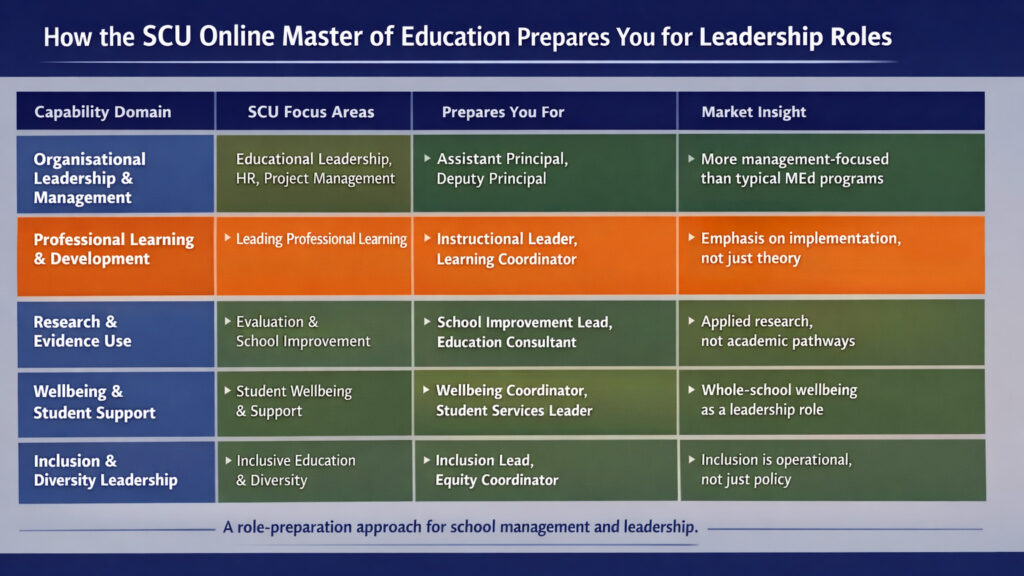
The SCU Online Master of Education is structured less as a teaching extension degree and more as preparation for organisational responsibility in schools and education systems.
Rather than assuming graduates want deeper subject pedagogy or academic research specialisation, the course is built around the transition many experienced teachers actually face: moving from individual classroom expertise into roles that involve staff oversight, program leadership, evaluation, and institutional decision-making.
The sections below break down the main career capability areas developed across the degree and explain the types of roles they prepare graduates for.
Move into school leadership and management roles
The strongest differentiator in the SCU program is its treatment of schools as organisations, not just learning environments.
Through leadership, human resource management, organisational behaviour, evaluation, and management-focused units, graduates develop capability in:
- supervising and managing staff
- leading structured change initiatives
- engaging with administrative and financial decision-making
- understanding how authority operates in real school settings
These capabilities align closely with roles such as assistant principal, deputy principal, executive teacher, and senior coordinator positions.
Many Master of Education programs emphasise leadership theory or curriculum leadership without equivalent exposure to operational management. SCU’s structure addresses that gap directly.
Lead other teachers, not just your own classroom
SCU places clear emphasis on leading educators, not simply refining individual teaching practice.
Units focused on professional learning and contemporary educational contexts prepare graduates to:
- design and lead staff development initiatives
- work effectively with professional learning communities
- embed research and improvement strategies across teaching teams
This capability is particularly relevant for teaching and learning leadership roles, where success depends on influencing adults, coordinating practice, and driving consistency across classrooms.
Use evidence to justify decisions and drive improvement
The research components in the SCU degree are applied rather than academic in orientation.
Rather than preparing graduates primarily for doctoral pathways, the focus is on:
- evaluating programs and initiatives
- using evidence to support and justify decisions
- responding to accountability, compliance, and improvement frameworks
From a career perspective, this supports roles such as school improvement lead, system-facing leadership positions, and education consultancy roles where evidence use is expected but academic publishing is not.
Take responsibility for wellbeing at a whole-school level
One of the clearest structural signals in the SCU program is that wellbeing is treated as a leadership responsibility, not a supplementary interest.
Multiple units address student wellbeing, leadership in this area, and supporting students in complex circumstances. This reflects how schools increasingly structure wellbeing roles, often at coordinator or executive level.
In many Master of Education programs, wellbeing appears as a single elective. At SCU, it is positioned as an ongoing area of responsibility tied to authority and leadership.
Lead inclusion and equity initiatives in real settings
Inclusion and diversity are approached as operational responsibilities rather than abstract principles.
The SCU curriculum focuses on:
- implementing inclusive practice
- supporting participation through collaboration and technology
- leading equity initiatives within institutional and regulatory constraints
This prepares graduates for inclusion-focused leadership roles where responsibility extends beyond classroom adjustments to whole-school practice, participation, and accountability.
How This Degree Compares in the Current Market

Without naming competitors, the SCU Online Master of Education differs from many Australian programs in three key ways:
- it places management and leadership execution ahead of curriculum specialisation
- it treats wellbeing and inclusion as formal leadership pathways
- it prioritises applied decision-making over academic research depth
This makes it particularly well suited to educators who expect to carry organisational responsibility rather than remain classroom-centred.
Who Should Seriously Consider This Degree
The SCU Online Master of Education is a strong fit if you:
- are an experienced teacher or educator
- are moving toward leadership, coordination, or management roles
- want practical authority, not just theoretical knowledge
- expect to influence staff, programs, or whole-school direction
It is less suited to those seeking:
- narrow subject specialisation
- a research-intensive academic pathway
Final Verdict from Mallory Careers
The career value of the SCU Online Master of Education comes from how it prepares educators for responsibility beyond the classroom.
The degree focuses on leadership, staff management, evaluation, wellbeing, and organisational decision-making. These are the capabilities schools assess when appointing assistant principals, coordinators, and executive teachers.
For educators aiming to move into roles with authority and accountability, this program aligns well with the expectations of the next career stage. It supports progression into positions where judgment, oversight, and whole-school responsibility matter.
